
Good practice guide: Complaint handling for local councils
Date posted:This updated guide provides advice on implementing new legislative requirements relating to complaints, using good practice complaint handling and building a positive culture around complaints. It includes practical tools including templates, real examples and a self-assessment tool for councils.
Quick navigation
I want to...
Foreword
Councils play an incredibly important role in our day-to-day lives; one that we often don’t notice until something goes wrong.
Councils make decisions about local roads, pools, parks and playgrounds, rubbish and recycling, regulations affecting how we build and renovate our houses, and many other issues that directly affect where and how we live.
It is unsurprising that, with so many decisions that have a direct impact on our lives, councils deal with many complaints.
When someone makes a complaint, they are often doing more than raising a personal concern. They are sharing feedback about how a service, process or decision has affected them and, in many cases, highlighting issues that affect others as well. This information creates a crucial opportunity for councils to improve the way they deliver their services.
Handled well, a complaint can resolve a problem quickly, strengthen relationships and build trust. It can provide insights into what is working well, what the community is concerned about and where there may be opportunities to make systems and processes fairer, simpler and more effective. Complaints offer a form of feedback that is both free and valuable. They help organisations learn, adapt and improve.
Unfortunately, complaints are not always handled well. People who come to us with complaints about councils are often frustrated not only by the original issue, but by their experience while trying to raise concerns about it. A missed phone call, a delayed response, a lack of explanation or an unfair process can do as much damage as the issue itself.
Good complaint handling is therefore much more than an administrative process. It is a demonstration of accountability, respect and a commitment to serving the community fairly. Importantly, good complaint handling can help to prevent future complaints.
The Local Government Act 2020 requires councils to have a complaints policy and process. These are important foundations, but the most effective complaint handling goes beyond policies and procedures. It is supported by leadership, a culture that values feedback, and a willingness to learn from mistakes when they occur.
We developed this guide specifically for Victorian councils to support that work. The guide reflects the principles of the Australian Standard Guidelines for complaint management in organizations and provides practical advice that councils can adapt to suit their local circumstances. It also draws on real examples and highlights some common traps to avoid.
Consistent with our Strategic plan 2025–29 and our focus on prevention, this guide is designed to help councils strengthen their complaint-handling practices, identify issues early and improve the quality of their services and administration.
Every complaint presents an opportunity to learn something new, improve an outcome and strengthen trust with the community. I hope this guide helps councils embrace those opportunities and continue building fair, responsive and accountable local government for all Victorians.
Marlo Baragwanath
Victorian Ombudsman
Structure of this guide
Section 1 includes key definitions and talks about the importance of a positive complaints culture.
Section 2 covers the different elements that make up a complaint-handling system and are crucial to ensuring consistent and effective complaint handling. This section is for council staff who are responsible for the set up, operation and oversight of the complaints system.
Section 3 talks about the process for best practice in handling each and every complaint. This section is relevant for anyone working in a council who is involved in complaint handling.
Appendix A is a model complaints policy for councils.
Appendix B shows a complaints handling process.
Appendix C includes model wording for written outcomes to investigations.
Appendix D lists additional resources.
Section 1: Key definitions and the importance of a positive complaint culture
What is a ‘complaint’?
The Local Government Act 2020 defines ‘complaint’ (section 107(3)):
For the purposes of the complaints policy, complaint includes the communication, whether orally or in writing, to the council by a person of their dissatisfaction with—
- the quality of an action taken, decision made or service provided by a member of council staff or a contractor engaged by the council; or
- the delay by a member of council staff or a contractor engaged by the council in taking an action, making a decision or providing a service; or
- a policy or decision made by a council or a member of council staff or
a contractor.
In simple terms, a complaint to a council is any communication which is:
an implied or express statement of dissatisfaction where a response is sought, reasonable to expect or legally required.
It includes dissatisfaction with a council or its contractors’:
- customer services
- actions or decisions
- inaction or delay
- policy or processes.
From time to time, your council might receive feedback rather than an
explicit complaint.
We define feedback as:
a compliment, criticism, comment or suggestion where a response is not sought, or not reasonable to expect.
Complaints and feedback can be distinguished by whether the person can reasonably expect a response. Like complaints, feedback is valuable and can help identify opportunities
for improvement.
Generally, initial requests for service, action or information are not complaints, although they do prompt action. Subsequent requests may be an implicit complaint about service, inaction or delay.
Recognising complaints
All staff should be aware of your council’s complaint-handling system to identify complaints and help people get to where they need to go.
Remember, not everyone who complains will use the word ‘complaint’.
Look for phrases like:
I’m not happy with …
It’s not fair that …
I’m angry about …
Why can’t you …
I don’t like …
Why didn’t you …
I don’t agree with …
Something’s gone wrong.
I want compensation for …
That sucks!
‘Complaint’ versus ‘service request’
The Ombudsman’s 2019 report Revisiting councils and complaints noted that councils classified complaints and service requests inconsistently.
Differentiating between a complaint and service request may not seem important if the problem is fixed. However, if councils do not properly record complaints, they cannot accurately measure their performance or use that information to improve services.
If the matter of a missed bin collection is resolved when it’s raised, even if it’s treated as a service request, that information must be recorded.
A matter can start as a service request and become a complaint if the person is dissatisfied with the council’s response.
Consider whether a person is:
- requesting something be fixed, done or provided (a service request)
- reporting what they believe to be a failing or a shortfall (a complaint)
- complaining about how a council handled a service request (a complaint).
| Complaint | Service request |
| You haven’t sent out my rates notice and now I’ve been charged penalty interest. | When will my rates notice will be sent? |
| The council shouldn’t have approved a development on Main Road. | How do I object to the development on Main Road? |
| My permit application has been delayed, and no one has been in touch with me for weeks. | Do I need a planning permit for a backyard pool? |
| Council’s investigation into my neighbour’s noisy business wasn’t done properly. You didn’t look into peak times; more investigation is needed. | My neighbour’s business is very noisy. Can you make it stop? |
| A pothole I reported to council three times hasn’t been fixed and is getting worse. | Could you fill in a pothole in my street? |
‘Complaint’ versus ‘claim’
The Ombudsman’s 2023 report Glen Eira City Council’s approach to contractor work examined how Glen Eira City Council responded to a resident’s concerns that stormwater pipes on his property had been damaged by footpath works undertaken by a council contractor. Rather than treating the resident’s correspondence as a complaint about a council service, the council characterised it as a claim for compensation and told the resident to pursue the contractor directly.
A key finding of the report was that the council drew an inappropriate distinction between a complaint and a claim.
A request for compensation can still be a complaint because it is fundamentally an expression of dissatisfaction.
By focusing on legal liability and classifying the matter solely as a claim, the council failed to handle it as a complaint, despite the broad definition of ‘complaint’ in both its own policy and the Local Government Act.
The report emphasised that councils remain responsible for responding to complaints about services delivered by their contractors, regardless of who may ultimately be liable for any damage. The council should have acknowledged the resident’s concerns, explained its decision-making more clearly, and managed the matter through its complaint process rather than treating it only as an insurance issue.
More broadly, the investigation highlighted inconsistent approaches across Victorian councils to complaints involving contractors. The Ombudsman recommended clearer guidance and procedures to ensure councils recognise that complaints about contractors’ services are still complaints about council services and should be handled accordingly.
Any ‘expression of dissatisfaction’ with the outcome or handling of a claim should be dealt with as a complaint. Councils should respond in line with their complaint policies and their customer service charters.
Importance of a positive complaints culture
Building a culture that welcomes complaints and shows that complaints matter is a key component of effectively handling complaints.
Complaints should be welcomed and valued by council staff at all levels. Complainants should be provided the opportunity to give feedback. Complaint data should be valued and used for systemic change and continuous improvement.
A positive complaint culture starts with the attitudes and decisions of the executive leadership team. Leaders need to encourage staff to view complaints as an opportunity to identify issues within the community or challenges in dealing with the council. Leaders need to champion organisational change based on complaint data and support staff who manage complaints on a regular basis.
Section 2: Implementing an effective complaint handling system
Members of the public have an expectation that when they complain, their council will properly consider and respond to their concerns. To achieve this, councils need to have an established complaint management system for receiving, managing and analysing complaints.
A complaint-handling system consists of all the elements that contribute to how an organisation handles and manages complaints. To build a good complaint-handling system, councils should be:
- implementing a four-tiered model for managing complaints
- determining a structure for how the different tiers of the model interact
- assigning responsibility for the implementation, functioning and oversight of the system
- identifying the right people and providing appropriate training and supports
- maintaining fit-for-purpose policies and procedures
- making the complaint process transparent and accessible to the community
- monitoring performance and learning from complaints.
Properly establishing all these elements ensures that each complaint is handled consistently and effectively, regardless of what it’s about, how it was received, and which person or team is assigned to handle it.
No single element on its own can ensure your council consistently handles complaints well – all the elements work together. For example, a council can have an excellent complaints policy but not train its staff. Or a council can have highly skilled complaint handlers but no complaint management software to track the progress of complaints.
This section of the guide offers practical suggestions about each element of the complaint handling system. The guidance is based on relevant standards our experience of carrying out complaint system reviews focused on local councils consultation with local councils; and a review of best practice guidance in other jurisdictions.
The four-tiered model
Councils should implement a four-tier model for handling complaints. In this model, each tier represents a point of escalation. This provides a clear and easy-to-understand pathway for complainants throughout the complaints process.
If the complaint cannot be informally resolved at tier 1 and needs further consideration, it moves to tier 2.
If the complainant believes the council has made a wrong decision, they can request an internal review. This moves the complaint to tier 3.
If the complainant still believes the council has made a wrong decision, provide them with information about how to seek an external review.
See Appendix B for a more detailed flowchart showing a complaint handling process with these four tiers.
Structuring the four tiers
While all councils should adopt the four-tier model, there are different ways to structure the tiers. There is no one-size-fits-all complaint-handling structure. The right structure will depend on the unique circumstances of your council, such as its size and the volume and nature of complaints it typically receives.
We have suggested four possible ways of structuring a four-tier complaint system, along with a summary of the benefits and risks of each. These structures range from a completely dispersed approach at one end of the spectrum to a completely centralised one at the other.
These four options are not exhaustive and are provided as a guide only. You should complete your own risk assessment to consider which structure best suits your council and how to mitigate any applicable risks.
Choosing the appropriate structure requires considering which people and teams within the council should be involved in each tier, and how the different tiers should interact. Your choice of structure will impact other aspects of your complaint-handling system – including roles and responsibilities, staffing and the allocation of other resources.
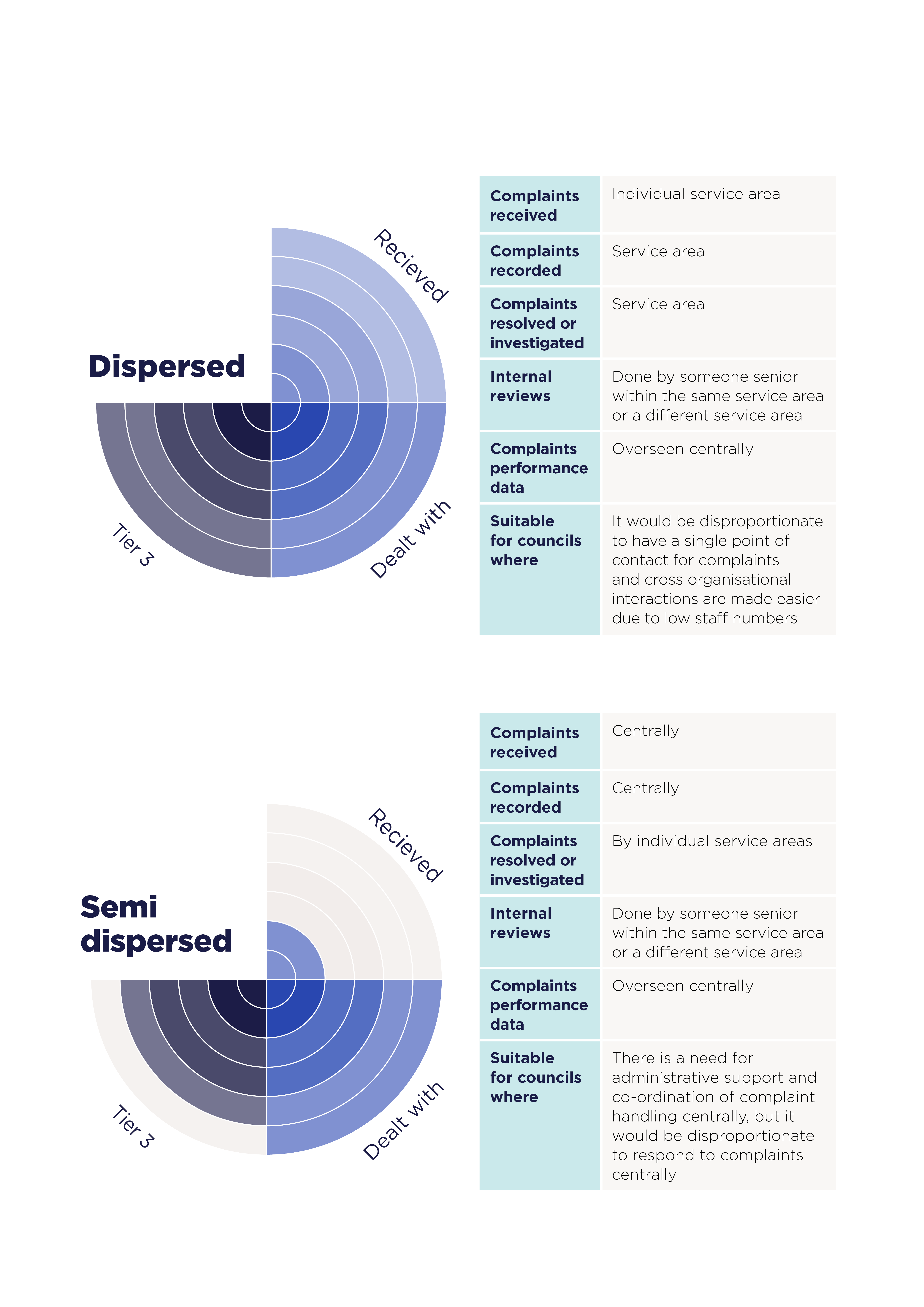
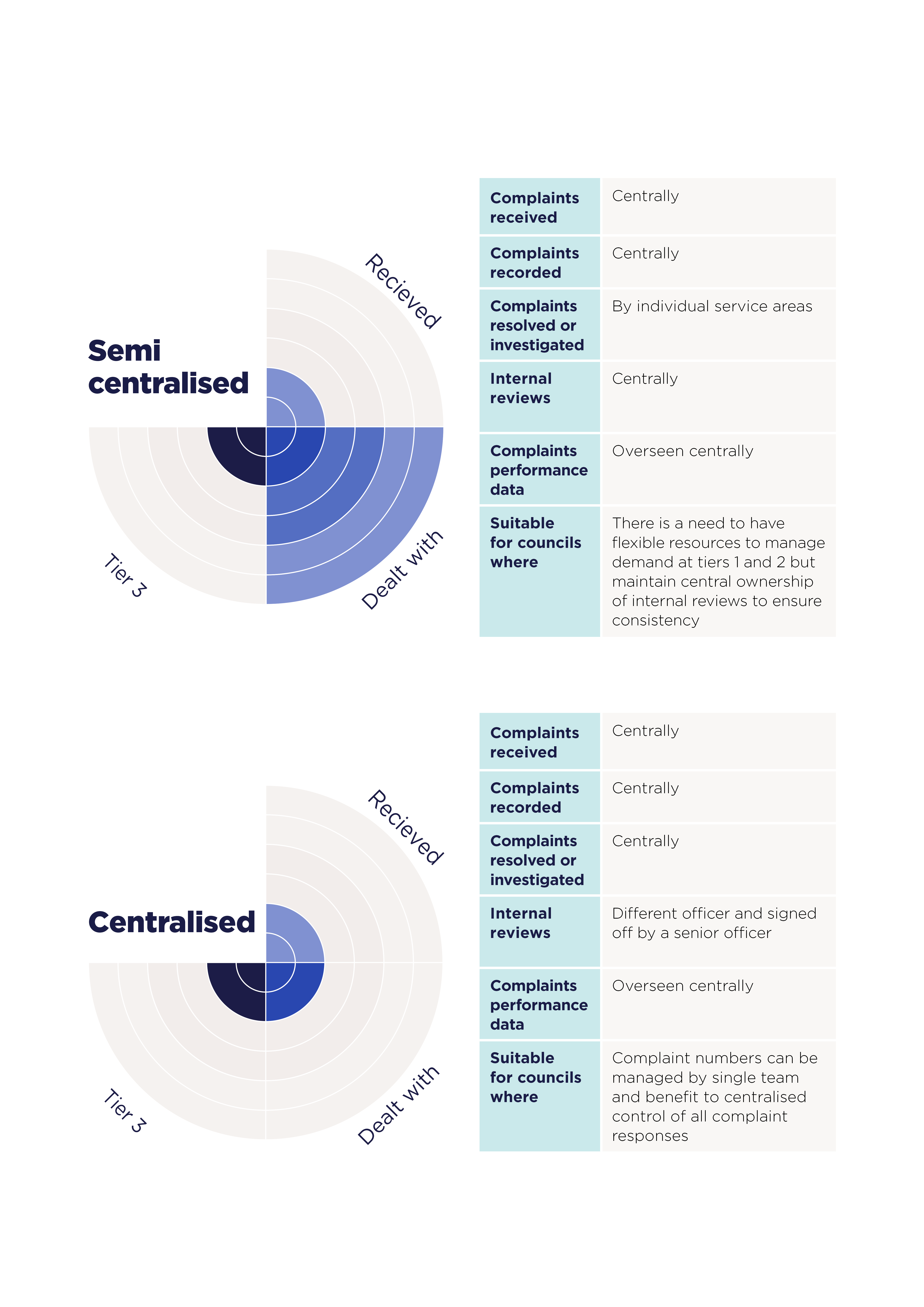
| Dispersed | Semi-dispersed | Semi-centralised | Centralised | |
|---|---|---|---|---|
| Service areas at the point of delivery are well placed to provide quick resolutions | ✓ | ✓ | ✓ | ✗ |
| Places responsibility for managing complaints effectively and improving services on the relevant service area | ✓ | ✓ | ✓ | ✗ |
| Service areas can move resources to deal with sudden unexpected rises in complaints | ✓ | ✓ | ✓ | ✗ |
| More consistency in identifying complaints through a central point of contact | ✗ | ✓ | ✓ | ✓ |
| Easier to identify complaints about more than one service area | ✗ | ✓ | ✓ | ✓ |
| Control over how complaints data is recorded | ✗ | ✓ | ✓ | ✓ |
| Oversight of the complaints process across the council | ✗ | ✗ | ✓ | ✓ |
| Practices of service areas can be checked and challenged at internal review stage | ✗ | ✗ | ✓ | ✓ |
| Easier to identify individual service areas where problems are found | ✗ | ✗ | ✓ | ✓ |
| Smaller proportion of staff need training in complaint handling | ✗ | ✗ | ✓ | ✓ |
| Responses are consistent and there is control over timeframes | ✗ | ✗ | ✗ | ✓ |
| Easier to drive cultural change across organisation in relation to end-to-end complaint handling | ✗ | ✗ | ✗ | ✓ |
Responsibility for the system
While the success of a complaint system depends on many staff, it is crucial that councils assign responsibility for the overall functioning of the system to a senior staff member. We will refer to this person as a complaint system manager.
The complaint system manager role may be performed by more than one person. It may be a standalone role, or part of an existing role. The key point is that there should be a clear site of responsibility for overseeing the various interconnected parts of the complaint system and its interaction with other council systems.
A complaint system manager’s responsibilities should include:
-
Implementing and maintaining the complaint management system, including:
- Determining structure for implementing the four-tier model
- Identifying relevant roles and responsibilities of different staff in the chosen structure
- Staff recruitment and training
- Implementation of appropriate technology
- Ensuring staff are supported by appropriate documentary guidance materials, including policies, procedures and templates
- Setting service standards or key performance indicators
- Conducting periodic reviews of the complaint system to identify areas for improvement
- establishing and overseeing processes for performance monitoring, evaluation, and reporting
- reporting to the executive leadership team and the council on the operation and performance of the complaint management system
- reporting to the executive leadership team and the council on significant complaints and systemic issues or trends
- reporting to staff and other relevant stakeholders about issues of concern identified through complaints.
Given the nature of these responsibilities, the complaint system manager should have suitable seniority within the council. They need appropriate authority and reporting lines to the executive leadership and the council.
People, training and support
Identification and resourcing
To ensure you have the right people, identify which areas of the council will be involved at each stage of the complaint process and what they will do.
This will influence:
- the number of staff required in different areas
- the levels of responsibility and delegation of authority
- the required skillset.
You will need to consider your council’s circumstances, including its size and the average volume of complaints it receives, as well as the complaint-handling structure your council has in place. For example, if your council adopts a more centralised approach, then resourcing will be weighted more towards a centralised unit than to dispersed service areas.
Training
Skilled, knowledgeable staff are the most valuable resource in any complaint system. Complaint handlers need a range of skills and personal qualities and skills including:
- empathy
- respect and courtesy
- discretion
- negotiation skills
- problem-solving skills
- strong communication and rapport‑building skills
- the ability to remain impartial.
It is crucial that all staff involved in the complaint-handling process receive ongoing complaint training relevant to their specific roles and functions.
As well as covering general complaint-handling and decision-making skills, training must also equip staff with adequate knowledge about the council’s policies and procedures; service delivery standards; and record-keeping practices.
Councils should also ensure that staff are supported by other resources. This could include a suite of fit-for-purpose templates (such as acknowledgment and decision letters), a library of resources explaining relevant laws and policies, and interactive forums such as communities of practice.
Empower your staff
Complaint handlers need to be empowered to manage complaints effectively. This means delegating the appropriate authority to staff dealing with complaints so they can make decisions and provide remedies. While not every complaint can be resolved by frontline workers, many can if these staff are given reasonable authority and understand when it’s appropriate to use their discretion.
Look after your people
Complaint handling can be difficult and stressful, and staff need support to maintain a healthy, positive attitude.
There are many hazards complaint handlers may face, including violence or aggression from complainants, unreasonable or excessive time pressures, high job demands and poor support.
Managing the risks associated with these hazards not only protects staff, but it also decreases turnover and absenteeism. It may also improve broader organisational performance and productivity.
Well-defined informal and formal supports will help minimise the negative impacts of complaint handling on your staff.
Informal strategies can involve managing caseloads, providing a buddy, limiting time spent answering calls and carefully allocating certain types of complaints.
Formal strategies can involve having a formal debrief, particularly after an incident. This could be conducted inhouse or through an employee assistance program. Having appropriate health and safety policies and procedures for your staff is also essential.
All-staff awareness
While not all staff will be directly involved in handling complaints, it is important that everyone at the council is aware of the essential elements of the complaint handling process. In particular, all staff should at least know where they can direct a member of the public who wishes to make a complaint.
This can be achieved by implementing an e-learning module on complaints as part of an induction, maintaining a prominent intranet page about complaints, and delivering periodic all-staff communications about complaints.
Policy and procedure
Policy
The Local Government Act requires councils to maintain a complaints policy and includes the following minimum standards for what must be included:
(b) a process for reviewing any action, decision or service in respect of which the complaint is made; and
(c) a discretion for the council to refuse to deal with a complaint which is otherwise subject to statutory review; and
(d) the prescribed processes for dealing with complaints about the council; and
(e) the prescribed processes for internal review of complaints made to a council; and
(f) the prescribed processes for exercising the discretion referred to in paragraph (c); and
(g) any other matter prescribed by the regulations.
A complaints policy should cover the full life cycle of a complaint, including:
- how and when a complaint can be made
- who is responsible for managing the complaint as it moves through different tiers
- target response times at each tier
- references to related processes or policies (such as a public interest disclosure procedure)
- how complaint data will be stored and used.
Each council needs to tailor its policy to suit its capacity and the needs of its community. A large council with a dedicated complaint or customer service team will have different processes from a small council where complaints are dealt with by a manager of the relevant area.
See Appendix A for a model complaints policy for councils.
Procedures
A complaints policy alone is not enough to ensure that a council’s complaints system operates efficiently and consistently. Council complaints policies tend to be written for both internal and external audiences and, as a result, they often outline the council’s approach to dealing with complaints at a high level only.
A policy will not provide sufficient detail for staff members to know their responsibilities, required actions and the relevant performance standards. To ensure a consistent and effective approach to complaint handling, this additional detail should be set out in complaint-handling procedures.
These may variously be referred to as manuals, guides or standard operating procedures.
These procedures act as a ‘how to’ guide for staff. They should cover all internal complaints processes from beginning to end – explaining how a complaint is to be handled at each stage and by whom.
For example, a policy might describe that if a complainant remains dissatisfied after an investigation, the officer investigating the complaint will refer it for internal review. A procedure should then describe the mechanics of this, including:
- who the investigator will refer the complaint to and how
- the timeframe for referring the complaint for internal review
- what information should be provided to the complainant
- any record keeping and data entry requirements related to the complaint management software.
Specific topics in policies and procedures
There are some topics we commonly see not being adequately addressed in council complaint-handling policies and procedures. As such, the following sections provide specific guidance on:
- dealing with complaints about contractors
- exercising discretion where there are legislative processes in place
- complaints about the CEO or decisions at council meetings
- handling matters that community members have raised with councillors.
Contractors and complaints
A council’s policy for complaint handling should apply to all aspects of the council’s operations, including any functions delivered by a contractor on behalf of the council. However, practices vary across the local government sector. This issue arose in our 2023 report Councils and complaints: Glen Eira City Council’s approach to contractor work.
Given that councils’ use of contractors is significant and widespread, and contractors have direct contact with the public, it is important that these activities are covered by a complaints policy. This approach helps the public get assistance with any problems they encounter. It also helps councils to identify problems with contracted services and manage their reputation.
A council’s complaints policy should cover all third parties including:
- contractors and their staff directly undertaking the contracted activity
- intern and volunteer staff
- consultants to the council.
The council’s policy should also be supported by clear procedures that explain to staff how it oversees complaints relating to contractors, including the actions, roles and responsibilities involved in overseeing contractors in different circumstances.
Contractors should be made aware that the council’s complaints policy and process applies to them at the tendering and contracting stage, or at induction for individual contractors. This will provide clarity and surety for the contractor at the outset and ensure they understand their obligations and responsibilities. By setting clear expectations around complaint handling, a council may also find it is able to better monitor the performance of its contractors.
In order to apply a complaints-handling policy to contractors, a council may have to periodically confer with the contractor. In some cases, a complaint may be easily resolved between the contractor and the complainant directly; however, this approach will not suit all complaints. In situations where direct communication is not appropriate, or not accepted by the complainant, the council should step in and manage the complaint to ensure it is resolved within a reasonable timeframe.
In other words, council oversight of contractor complaints will not always require a council to directly handle complaints about contractors. But, equally, a council should never entirely exclude itself from complaint processes involving its contractors.
Even when a contractor’s work is finished, the council remains ultimately responsible for considering and processing a complaint, irrespective of the complaint originating with a contractor. A council’s complaint-handling policy should not allow a council to exclude itself from the complaints process, regardless of whether a complainant is requesting compensation as part of their complaint.
Good practice for contractor complaints includes a council-led investigation where appropriate, council directly liaising with any relevant third parties and a timely outcome for the complainant with details of any investigation and findings. Regardless of whether a complaint is initially dealt with by a contractor or the council itself, complainants must have access to the council’s internal review process.
| Scenario A A council hires a contractor to undertake a six-week project to remove trees from several nature strips. Given the contractor is a small business with a limited number of administrative staff, the council decides it will handle any complaints that arise. The contract and the council’s procedures specify the council division that will communicate with complainants and what assistance will be required from the contractor when managing complaints. |
| Scenario B A council engages a large company on a long-term basis to carry out street cleaning. The council decides that the contractor will directly handle complaints at tiers 1 and 2 but requires monthly complaint performance reports. It also decides that all requests for internal review must be referred to the council. These arrangements are reflected in the contract and in council procedures. |
The discretion to refuse to deal with a complaint which is otherwise subject to statutory review
The Local Government Act gives councils the discretion to refuse to deal with a complaint that could go through a statutory review process. This means any complaint for which there is a review or appeal process to a tribunal or court, under an Act or regulation. Complaints of this type usually concern a particular matter, such as infringements, planning or public health.
This option is a discretion only. Councils can still choose to deal with these complaints through their usual complaints process. Council complaints policies must include an explanation of the process it follows to determine whether or not to use this discretion. This ensures that councils can provide the complainant with reasons for the decision.
A council’s reasons for refusing to deal with a complaint which is otherwise subject to statutory review might include:
- the statutory review process already being underway
- it being reasonable in the circumstances to expect the complainant to go through that review process
- a tribunal or court being likely
- to settle the matter faster
- the complaint relating to a specialised area and it being proper that a tribunal or court make a binding determination on the matter, as this could set a precedent.
In some circumstances, it can be better for both the council and complainant to deal with a complaint directly, without using the statutory review process – for example, where a satisfactory resolution can be achieved faster and at lower cost.
A council decision not to exercise the discretion does not waive the complainant’s right to access the statutory review process.
Complaints about the CEO or decisions at council meetings
There are some council employees and decisions that stand outside the usual oversight and reporting lines – the CEO and decisions made at council meetings. Councils should develop specific procedures for managing complaints about these. These procedures should cover:
- where the complaint should be directed
- who will deal with the complaint and in what circumstances
- what measures are in place to protect the integrity of any investigation
- how to document the complaint process and the outcome
- when complaints might be referred to the Local Government Inspectorate, the Victorian Ombudsman or IBAC.
When a councillor receives a complaint
Councillors are often the ‘face’ of their council and residents can see them as having the means and power to fix problems. When councillors receive complaints directly from their constituents it can result in their role being misunderstood; complaints being handled outside of established processes; and inconsistent data capture and tracking.
Setting out steps in your complaint handling policy and procedures will help both councillors and council staff manage complaints consistently. For councillors, these steps may include:
- referring complaints about council operations to a designated officer or team
- informing a complainant their complaint has been referred to council administration
- following protocols for interacting with council staff (including not seeking to influence or direct council staff on how to deal with the complaint).
For council staff dealing with a complaint referred from a councillor, procedural steps may include:
- dealing with the complaint in accordance with the council’s complaints policy
- communicating directly with the complainant, including providing and signing any written response
- informing the councillor of the outcome after the complaint is finalised.
Transparency and accessibility
ransparency and accessibility are crucial for ensuring the successful operation of a complaints system and for building public trust. Transparency is about ensuring people know how to complain and what to expect when they complain. Accessibility is about ensuring that people are able to participate in the complaints process without any undue barriers.
Councils can make it easy for people to complain by publishing information about how to complain and the complaint process. One way of doing this is by publishing your complaints policy on your website5 and making it available to the public in other ways (such as having printed copies available at service centres).
But it is important to note that policies can be lengthy, and not all members of the public will find them easy to understand.
This is why councils also need to maintain user-friendly complaints information on their website that is easy to find using a search tool. This should summarise the essential information from the policy that is most relevant to a person wishing to complain. It should include:
- how to make a complaint
- when to make a complaint
- a complaint form to help the complainant to include the required information, or advice about what information to provide (incident details, the impact on the complainant, what outcome they are seeking and any supporting materials)
- guidance around common complaints and how they might be resolved
- summaries of the different tiers and associated timeframes
- advice on how to check on the status of a complaint.
Councils can also enhance the transparency of their complaints process by including details of how to complain as part of any correspondence with members of the public.
Publicising how to complain: Brimbank City Council
| Report it – Feedback or complaint about council form | Complaints to the Ombudsman If you have a complaint about council, you can complain directly to the Victorian Ombudsman. | Feedback and complaints overview We value all feedback – positive and negative. Let us know what you like, where we might be able to improve or if you have a serious concern. | Request for compensation We are committed to the health and safety of our community, but sometimes unexpected events can lead to injury or loss. |
Ensure the complaint process is accessible and easy to understand
We live in a diverse community, and people’s communication needs may differ for many reasons including disability, age, literacy, health or past trauma. Language barriers, homelessness or shift work can also inhibit people from accessing your organisation.
Councils can make their complaints processes more accessible by tailoring communications to a complainant’s particular needs and circumstances. This means:
- accepting complaints by telephone, letter, email, online and, if possible, in person
- providing information in a range of languages
- offering free access to a translation and interpreter service
- providing information in accessible formats such as large print, Braille, audio and video formats including Auslan, text-to-speech and Easy English
- using the National Relay Service to communicate with people who are Deaf or hard of hearing, or who have a speech or communication difficulty
- adhering to Web Content Accessibility Guidelines
- providing support to complainants if needed
- allowing authorised representatives to act for or help people make and manage complaints.
Sophisticated complaint systems also recognise that accessibility is about more than communication. Some parts of the community may be less likely to complain for cultural or other reasons.
By comparing the demographics of the people who use your services, and the demographics of those who complain, you can identify groups that are under-represented. To better engage these under-represented communities you can work with stakeholder and advocacy groups and conduct outreach activities.
Protect people who complain from detrimental action
Sometimes people are reluctant to complain because they fear reprisal. This can be particularly problematic for people who rely on councils for their daily living needs, such as people using social services or other welfare. For some, it can be a challenge to get past the old saying ‘don’t bite the hand that feeds you’.
To help overcome this, in addition to welcoming complaints, your complaint-handling system should make it clear that you will take all reasonable steps to protect people from reprisal.
Reprisal against a person for making a complaint could be improper conduct under the Public Interest Disclosures Act 2012 and must be taken seriously.
Performance and improvement
Recording complaints systematically
Councils must ensure that complaints are consistently and accurately recorded. Even when a complaint can be resolved immediately, it is important to record the complaint and resolution provided so that the council can make accurate and data-led decisions.
Councils need to capture all relevant information about the complaint, including all relevant correspondence and other documentation. This is important for:
- effectively tracking individual complaints and assessing compliance with procedures and performance standards
- assessing the performance of the complaint system overall by analysing performance data
- identifying thematic trends and issues by analysing aggregate complaint data.
For this to be achievable, a council needs a fit-for-purpose database that can be accessed by any staff involved in the complaint-handling process. The database must allow for appropriate data entry and have the capability to extract and analyse the complaint data.
While some smaller councils may be able to rely on simple methods like a spreadsheet, most councils will require specialised case management software or to integrate complaint handling into existing customer service systems.
Councils should ensure the program used can record and report on the following:
- the complainant’s name and contact details
- how and when the complaint was received
- communication preferences and any support requirements, such as an interpreter service
- demographic data (collected with the complainant’s consent), such as age, disability, language or cultural needs or whether a person identifies as Aboriginal or Torres Strait Islander
-
the substance of the complaint according to a list of categories:
- by service (e.g. waste collection, property valuation, rates, parking permits, library services)
- by issue (e.g. failure to provide a service, unreasonable cost, excessive enforcement, delay with communicating or making a decision)
- the different tiers or stages of the complaint process
- the staff member responsible for handling the complaint
- the outcomes of the complaint
- any remedies or follow-up actions taken in response to the complaint
- any recommendations for improvement arising from the complaint, including who is responsible for implementing the recommendations.
To ensure data quality, councils should train staff on using complaint management software and recording complaint information consistently. Councils should also periodically audit data quality.
Scenario: Incomplete data provides incomplete picture
Twenty-five people call complaining about the same issue. The complaint handler quickly resolves each complaint over the phone and decides not to record either the complaints or outcomes on the database. This limits the council’s ability to analyse this sudden spike in complaints and identify a possible systemic problem. This may have knock on effects on frontline staff capacity if similar phone complaints continue and are resolved on a case-by-case basis.
Analysing complaint data to improve services
Sometimes individual complaints are about a systemic problem but to identify this, councils need to look at their complaint data.
Periodic analysis of aggregate complaint data will help identify systemic and recurring problems and areas where services need to improve. As part of your analysis, you should interrogate data trends and consider the underlying drivers for these. It is useful to consider:
- the number of complaints you’re receiving
- the types of issues or services being complained about
- the outcomes of the complaints
- the demographics of complainants
- any trends over time – such as increases or decreases in the volume or proportion of complaints.
Monitoring performance data to improve complaint system
To monitor the performance of your complaint system, councils should set key performance indicators and use aggregate complaint data to periodically measure actual performance against these.
Your key performance indicators could include:
- complaint outcomes, including whether decisions were upheld, partially upheld or not upheld
- how long it took to manage complaints (either in total or at each tier)
- any service changes or improvements resulting from a complaint or complaint data analysis
- the number of complaint outcomes altered following an internal review
- the number of complaints escalated to the Victorian Ombudsman or other external avenues for escalation resulting in changes to your decisions, policies or practices.
- the number of complaints escalated to the CEO
- customer satisfaction, measured through surveys or by monitoring social media.
Reporting complaint and performance data
Councils should report on their complaints both internally and publicly.
A council’s complaint system manager should regularly analyse complaint and performance data and report to the council’s executive leadership and to councillors.
Periodic reports ensure that analyses are performed regularly and consistently. They also provide useful forums for discussing data trends and driving improvement actions.
For transparency and to support public trust, councils should also publish complaints data in annual reports or on their websites. This demonstrates the council’s commitment to improving its services and also enables councils to compare their performance and learn from each other.
Reviewing your system
It is helpful to regularly review your complaints system to ensure it remains up to date with the law and good practice, and continues to meet community expectations.
A review every two years should consider:
- changes to your council’s functions or organisational structure
- any changes to statutory or
- regulatory requirements
- technological changes
- results of your complaints monitoring, including results from any satisfaction surveys, audits and complaint-handling performance reviews
- feedback from external bodies such as the Victorian Ombudsman and other stakeholders
- current best practice
- the views of your staff.
It is also important to check how your complaints system is resourced to ensure it continues to meet demand by considering:
- whether the chosen complaint structure remains the most efficient and effective way of implementing the four-tier model
- the number of staff dealing with complaints compared with the number and nature of the complaints received
- the currency and appropriateness of training provided to staff
- the clarity of complaint-handling procedures and other documentation
- the level of support provided to staff
- the adequacy of equipment and software.
Section 3: Elements of good complaint handling
Responding effectively to complaints involves investing time and resources. While the benefits may not be immediately evident, research shows it can increase public trust, staff productivity and wellbeing, and compliance with the council’s laws and processes. This in turn can lower council costs.
Although there is no ‘one-size-fits-all’ approach to complaint handling, effective complaint processes consider the following elements:
- Timeliness
- Explain your process
- Triage and initial assessment
- Treat complaints fairly
- Consider human rights
- Confidentiality and privacy
- Evidence-based and objective decision making
- Communicate outcomes effectively
- Provide outcomes with clear reasons
- Provide internal and external review options
- Manage complex complainant behaviour.
Timeliness
Timely communication with members of the public is a cornerstone of a responsive complaints system.
Timelines can also influence a person’s perception of fairness and their satisfaction. Delays can frustrate people, particularly where penalties or interest grow while the complaint is being considered. Delays can also lead people to escalate complaints to the Ombudsman or other oversight bodies.
Complaints about delays can be avoided if you acknowledge and respond to complaints promptly. Complaints should be acknowledged within three business days, or sooner if the matter is urgent.
Councils should respond to all complaints unless you have previously told the complainant that you may not respond. (See ‘
Managing complex complainant behaviour
’ for
more information.)
The Australian Standard recommends straightforward complaints be dealt with within 30 days.
If the complaint is complex or needs more detailed investigation, give the complainant an expected timeframe and update them on progress regularly, even if there has been no progress.
You should review complaints that are older than 30 days and escalate them if necessary to expedite a resolution.
Where a complaint involves multiple areas of council, it’s helpful to coordinate your response to avoid confusion and double handling.
If the complainant does raise new issues, they need to be assessed on their merits. You may need to treat them as a new complaint to avoid delaying your process.
Setting service delivery timeframes: Knox City Council
-
When you make a complaint, we’ll let you know we’ve received it. How quickly we acknowledge your complaint depends on how you contacted us (for example, phone, email or online form).
- Phone or in-person: You will receive an email acknowledgement within 1 business day.
- Website: You will receive a verbal acknowledgement immediately.
- Social media: You will receive a direct message acknowledgement within 1 business day.
- Email: You will receive an email acknowledgement within 3 business days.
- Mail: You will receive a verbal or email acknowledgement, based on the contact details you have provided, within 3 business days from when we receive the mail.
- If a response to your complaint is not possible (or likely) within 20 business days, we will write or speak to you with an estimate of when we expect to contact you with a resolution.
- We will inform you of the outcome of your complaint either in writing or verbally, unless agreed otherwise, and will explain our reasons. We will attempt to provide this within 20 business days of receiving your complaint. If we are unable to provide a response within this timeframe, we will contact you and provide a revised timeframe.
Why acknowledging complaints is important
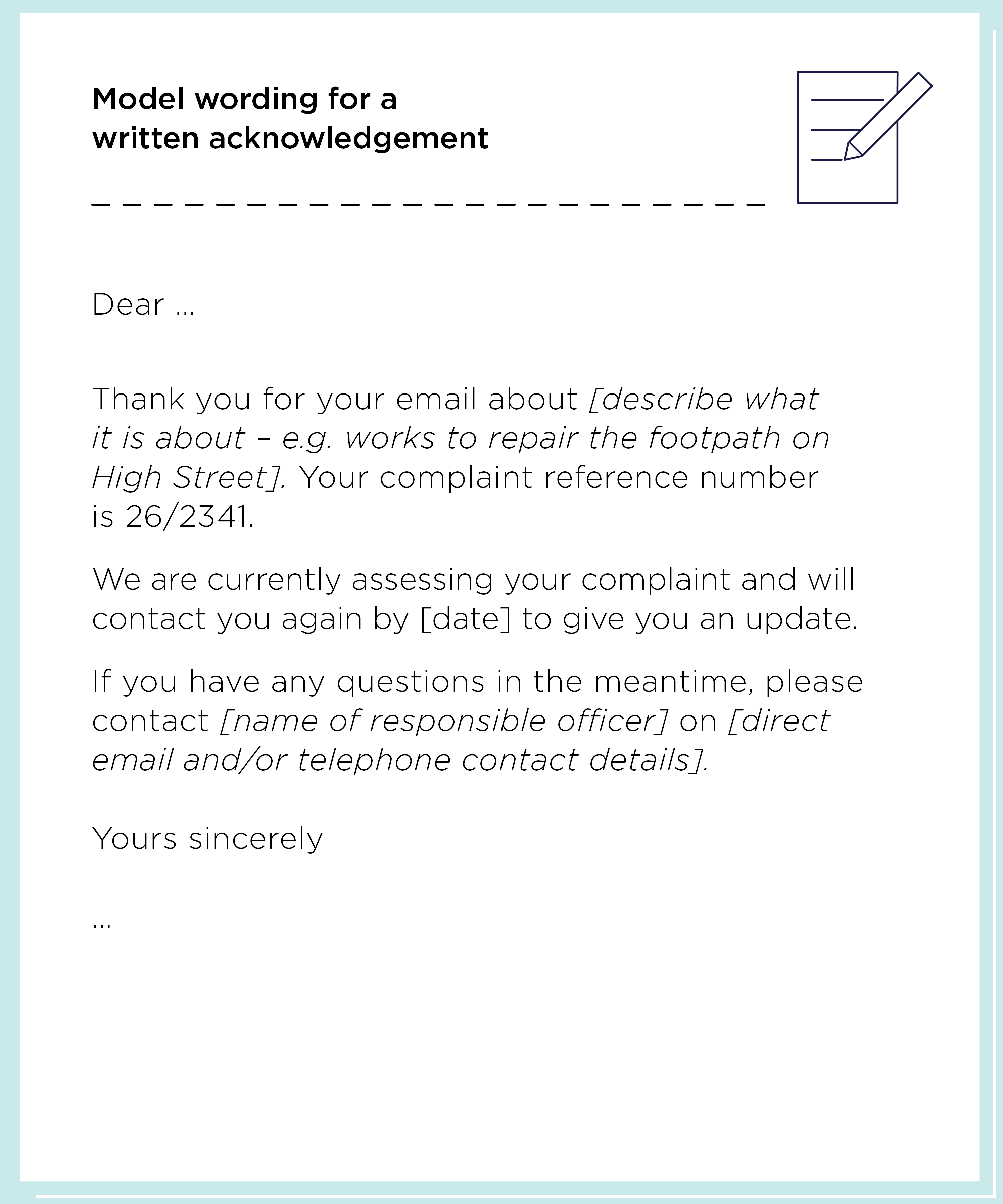
Acknowledging a complaint is a statement of commitment. It confirms receipt of the complaint but also tells the complainant that a council officer will take time to consider their concerns and respond. It is often a person’s introduction to the complaint process and can set the tone for future contact.
The best acknowledgements explain what will happen next and by when, and who to contact with further queries. It is helpful to provide a reference number.
Explain your process
Explaining your complaint process to complainants at the start promotes transparency and ensures that people know what to expect. Helping the complainant understand the process can help manage their expectations and reduce the risk of unreasonable behaviour.
When a person contacts their council, they may expect an instant response or feel entitled to get what they want as a resident or ratepayer. They may also have unrealistic views about the remedies you can provide, such as compensation or having someone fired.
Tell people:
- how their complaint will be dealt with
- who is handling their complaint and how to contact that person
- what issues you are considering
- when they can expect a response
- their likely involvement in the process
- the possible or likely outcomes.
It’s also useful to manage expectations by:
- asking what they want to achieve
- assessing whether their expectations are reasonable and achievable
- explaining what your council can and cannot do, or will and will not do
- identifying any issues over which you have limited control, such as statutory requirements or budget constraints
- providing alternative avenues for them to manage their complaint if your council cannot help.
In some cases, it can help to confirm your advice in writing – for example, where the complainant has already expressed unrealistic expectations.
If you are unable to meet your council’s timelines for any reason, let the complainant know as soon as you can and explain the reasons for the delay.
People are less likely to complain to the Ombudsman if you keep them informed about what is happening with their complaint.
Triage and initial assessment
Council resources are finite. Early assessment of a complaint helps councils prioritise and allocate resources fairly. It is also the most efficient way to get a prompt and proportionate response for every complaint.
A triage process looks at what the complaint is about and determines how to respond and who should do it. It takes into account the seriousness and urgency of the issues and the risks. To assess a complaint, you will need to clarify the details and determine what outcome the complainant is seeking.
If a complaint falls outside your council’s responsibilities, tell the person as soon as possible and refer them to an organisation that can help them.
AI generated complaints
Increasingly people are using AI tools to help them draft complaints. While some community members find these tools helpful for structuring correspondence, AI-generated content can complicate and delay the complaint handling process.
AI-generated complaints often contain:
- inaccuracies and misleading information
- fictitious authorities
- lengthy legal language
- irrelevant legal arguments and references to procedural fairness, human rights, negligence, natural justice or other legal concepts that may not be relevant to the issue being raised.
A council’s role is to identify and address the underlying complaint, regardless of how it was drafted. A complaint should not be rejected solely because it appears to have been written using AI.
However, officers should be aware that AI-generated submissions may not accurately reflect the complainant’s circumstances and may contain false or irrelevant information. The focus should remain on the actual events, impacts and outcomes sought by the complainant.
If an AI-generated complaint is unclear, council should request clarification. For example:
To help us assess your concerns, please briefly explain in your own words what happened and what outcome you are seeking from council?
It can also help to encourage people to call and explain their complaint over the phone and to have some general advice on your complaints page advising against using AI to write complaints. The Ombudsman uses the following:
You don’t need to use an AI tool like ChatGPT to make a complaint. We’d rather hear what happened directly from you, using your own words.
Model for triaging complaints: Keep, Transfer or Decline
In this model, frontline line staff are delegated to decide whether to:
Keep and resolve the complaint. This requires triage officers to have the necessary delegation to resolve the complaint.
Example: A customer service officer keeps a complaint about a missed bin because they can resolve the complaint by lodging a service request on behalf of the complainant.
Transfer the complaint to a particular team or person, if it requires specialist expertise, advice or investigation.
Example: A customer service officer transfers a complaint about a business’s overflowing rubbish bins to the council’s Public Health unit, because it has the expertise to investigate and provide advice to the complainant.
Decline the complaint if there is a more appropriate pathway the complainant should use.
Example: A customer service officer declines a complaint from an objector to the council’s decision to grant a planning permit, because they have a right of statutory review.
When is a complaint ‘resolved’?
It is not always possible to resolve complaints to the satisfaction of the complainant.
Councils are bound by legislation and the public interest when identifying a remedy to a complaint.
For councils, a complaint can be ‘resolved’ where:
- the complainant is satisfied with the action taken by the council
- the issue identified by the complainant has been fixed
- further action is unnecessary or unjustifiable because reaching a mutually agreeable solution would disproportionately consume council resources
- the council is confident that their response to the complaint would likely be upheld, if it were externally reviewed.
Factors to consider when triaging complaints
| Impact and risk | Outcome and other considerations |
|
|
Treat complaints fairly
For many complainants, being treated fairly during the complaint-handling process is just as important as the outcome. In fact, people are more willing to accept an outcome if they believe the process to reach that outcome was fair.
All complaints should be treated equitably, and there are many ways to promote fairness:
- Talk to people on all sides of the complaint. Find out the facts, establish common ground and verify information wherever possible. Check information and asking questions shows that you are listening.
- Consider each case on its own merits.
- Protect the complainant’s identity as much as is reasonable.
- Avoid bias and deal with any real or perceived conflicts of interest.
- Ensure complaints about particular council officers are handled by someone independent.
- If your council needs to make any decisions or take any actions that are affected by the complaint, put these on hold until the complaint is finalised, whenever this is possible.
If someone complains about a council officer, that officer is also entitled to be treated fairly.
Subject to any legislative restrictions, such as those in the Public Interest Disclosures Act 2012, councils should:
- inform the officer of the complaint
- give the officer an opportunity to respond
- keep the officer informed of progress of any investigation and the final result, with reasons.
The focus of the complaint-handling process is resolving the problem and continuous improvement.
If the council determines that a disciplinary process is warranted, it should be dealt with separately from the complaint-handling process.
Consider human rights
The Charter of Human Rights and Responsibilities Act 2006 (‘the Charter’) is an Act of the Victorian Parliament that sets out the rights and freedoms shared by everyone in Victoria and protected by law. The rights and freedoms in the Charter include, for example, the right to equality and non-discrimination, protection from cruel, inhuman and degrading treatment, the right to liberty and security, privacy rights, property rights, freedom of association and freedom of expression.
The Charter requires all public authorities (state and local government and associated organisations) to act compatibly with human rights and make decisions that give proper consideration to human rights.
In relation to human rights, there are three key questions to ask when assessing a complaint:
- Is a Charter right relevant to the complaint?
- If so, did the public authority impose a limitation on the right?
- Was any such limitation reasonable and necessary (i.e. proportionate)?
Some people might expressly complain about their human rights being interfered with. More often, however, people simply complain about the action or decision they are unhappy with.
Councils with the best complaint-handling systems will consider human rights as part of managing every complaint they deal with. In identifying whether a complaint raises human rights, you could consider, for example, whether the action or decision:
- restricted people – in their movement, where they live, are they detained
- impacted someone’s privacy
- involved children
- related to someone’s care or protection
- had a particular impact on different groups in the community – for example, Aboriginal and Torres Strait Islander people, people from culturally and linguistically diverse backgrounds, LGBTIQ people, people with a disability, women, young people or older people.
For more information, see our Good practice guide: Managing complaints involving human rights.
Confidentiality and privacy
Councils receive personal information about individuals and businesses in the course of carrying out their functions. Councils have an obligation to responsibly collect, handle and protect personal information under privacy and information laws. They must also tell individuals about why they are collecting their information and how it will be handled and used.
Personal information gathered from a complainant during complaint handling must only be:
- used to deal with the complaint or for a reasonable secondary purpose, such as monitoring complaint trends
- accessed by council staff where necessary to deal with the complaint, or for a related secondary purpose
- de-identified if it is going to be publicly released – and it can only be released publicly if it cannot be re-attributed to a person.
Ensuring that personal information is stored securely helps prevent unauthorised access, modification or disclosure of the information.
Establishing information governance ensures your council meets its obligations to protect privacy while also allowing it to analyse and use information to improve council services.
Evidence-based and objective decision making
Relying on evidence and exercising objectivity are also essential to a fair complaint-handling process.
While all investigations are about fact‑finding, they can vary depending on:
- the seriousness and extent of the issues
- the availability of relevant information or evidence
- the degree of certainty required to determine what action (if any) to take
- the outcome sought and potential for a satisfactory resolution.
Every investigation involves:
- considering the complaint impartially, but avoiding, declaring and managing any conflicts of interest to remove any actual or perceived bias
- gathering information from a range of sources including the complainant and council systems and staff, experts, third parties and external resources
- critically analysing the evidence by considering the different perspectives, and the reliability and relevance of the information, then deciding whether, on balance, the evidence tends to support the complaint or not
- examining not only whether the council followed legislation or policy, but also whether its actions were fair and reasonable
- focusing on whether a solution can be reached
- forming conclusions that are rational and logical, supported by evidence and reasons, and that can stand up to external scrutiny
- keeping good records.
The nature of investigations will vary. For example, an investigation of a complaint about the council not repairing a pothole may look at the council’s service request and road maintenance logs and involve a site inspection. However, a complaint about a council officer behaving inappropriately may involve appointing an independent investigator to interview witnesses and staff, review CCTV footage and incident reports, obtain legal and HR advice, and prepare a formal investigation report.
Finding a solution
When attempting to find a solution, your council can look beyond what the complainant says they want, to what action would be practical and proportionate. Solutions may be:
- acknowledging the wrong and the harm to the complainant and providing a sincere apology
- providing a better explanation for your council’s decision or actions
- reversing your council’s decision, explaining why the error occurred and the steps your council is taking to prevent it happening again
- making systemic change to your council’s policies or system
- correcting records
- providing a payment or compensation
- waiving fees, charges or debts
- providing some other outcome sought by the complainant.
The remedy should be fair, practical and proportionate to the seriousness of the issue.
Communicate outcomes effectively
Often an outcome is best communicated through a conversation. This gives the complainant an opportunity to ask questions and gives council staff the opportunity to explain the rationale behind the outcome and ensure the complainant has understood.
However, where the council has conducted a substantial assessment or investigation, it is better to provide the outcome in writing. A written outcome sets out how the decision was reached, as well as what the council or complainant can do next.
Regardless of how a final outcome is communicated, it is almost always helpful to have a conversation first. This promotes fairness by giving complainants another opportunity to be heard. It can also lead to better outcomes:
- The complainant may have extra information or evidence you have not considered.
- It can be easy to misunderstand or overlook parts of complex complaints, and the complainant may be able to clarify the issues.
- It gives the complaint handler a chance to check they have not misunderstood or overlooked important parts of the complaint.
The complainant may dispute some of your facts and findings. This ‘foreshadowing’ conversation can ensure disagreements are addressed before the complaint is finalised. If you can address areas of disagreement before you finalise the complaint, the complainant may be more likely to accept the outcome.
Provide outcomes with clear reasons
Providing clear reasons for decisions displays fairness, transparency and accountability. It helps the complainant understand why you made your decision, whether or not you upheld their complaint.
When we make enquiries with councils, we often find they provide us with convincing explanations for their actions. However, they have failed to communicate these to the complainant. If clear explanations for decisions had been provided, the complaint might not have been escalated to us.
Councils should communicate the outcome of a complaint to the complainant clearly while considering the complainant’s communication needs and preferences.
Good outcome letters:
- stay factual
- avoid jargon
- briefly describe the complaint and identify the issues
- explain the steps you took to investigate or manage the complaint
- clearly identify the outcome
- provide reasons for your decision
- describe any remedies that are being offered.
You should also:
- give the contact details of a council officer the complainant can contact to discuss the outcome
- offer information about escalating their complaint for an internal review or appeal
- advise the complainant of the Victorian Ombudsman and any other relevant external review options.
See Appendix C for a model template for writing outcomes to investigations.
Avoiding bureaucratic responses
Councils make decisions under legislation and policies. Template outcome letters that simply refer to the legislative or policy basis for a decision, without a plain language explanation, can appear bureaucratic.
| ✖ | Bureaucratic example: |
| Your application does not meet the eligibility criteria for a financial hardship plan, pursuant to clause 6(a)(iii) of the council’s Financial Hardship policy. | |
✔ | Plain language example: |
| Under our Financial Hardship policy, we cannot offer you a payment plan. This is because your income (which includes assets such as your home and your investment property), is above the threshold. | |
✖ | Bureaucratic example: |
| Your claim for compensation for damage caused to your vehicle is declined in accordance with section 102(1) of the Road Management Act which provides that a road authority [the council] is not liable in any proceedings for damages, whether for breach of the statutory duty imposed by section 40 or for negligence, in respect of any alleged failure by the road authority to remove a hazard or to repair a defect or deterioration in a road. This decision is not reviewable. | |
| ✔ | Plain language example: |
| We have not accepted your claim for compensation. You said your car was damaged by a large pothole on Main Street at 2.15am on Tuesday 7 June. This pothole was created by heavy rain after 10pm on Monday 6 June. Our records show that until now, there have been no reports of potholes or other hazards in Main Street. Because we were not aware of the pothole at the time the damage occurred, we are not liable for the damage under section 102(1) of the Road Management Act. If you have car insurance, you may wish to contact your insurer to make a claim under your insurance policy. |
Providing internal and external review options
Under the Local Government Act, councils’ complaints policies must include a process for internal reviews.
An internal review looks at whether a complaint was managed appropriately and whether the decisions were sound. Internal reviews should be undertaken by a senior officer who has not been involved in the original complaint. This ensures the process is as independent as possible.
Internal reviews follow good complaint-handling steps, including:
- acknowledging the review request
- explaining the process, including the timelines for conducting the review, what it will and will not look at, and the possible outcomes
- providing the complainant and any other parties with an opportunity to present their case
- providing a written outcome, together with reasons, and details of any remedies
- offering external review options, if parties are dissatisfied with the outcome.
In appropriate cases, you might also consider using alternative dispute resolution methods, such as conciliation to try to manage the complaint.
A review by a senior council officer may uphold the original decision or overturn it. If a complainant remains dissatisfied with the outcome after it has been escalated, you should inform them of any relevant external avenues of complaint or appeal.
These include:
- the Victorian Ombudsman
- statutory rights of appeal such as a merits review at the Victorian Civil and Administrative Tribunal (‘VCAT’).
‘Internal ombudsman’
The term ‘ombudsman’ refers to an independent office which provides a free and impartial means for resolving disputes between the citizen and their government.
Some councils use the term ‘internal ombudsman’ for someone who deals with complaints. In most cases, the internal ombudsman performs an internal review function for the council.
Referring to a council officer as an ‘internal ombudsman’ is problematic because they are not, and cannot be, independent of the council. Essentially, the term ‘internal ombudsman’ is an oxymoron. It is also confusing for complainants. Councils should not use this term. Use terms such as ‘internal review officer’ instead.
Manage complex complainant behaviour
The reality is that sometimes complainants will be frustrated, distressed or simply communicate in ways that may be confusing or confronting for council staff. The Ombudsman defines ‘complex behaviour’ as any complainant behaviour that your staff find difficult.
Sometimes complex behaviour becomes ‘unreasonable’. Unreasonable conduct is behaviour which, because of its nature or frequency, raises substantial health, safety, resource or equity issues for complaint handlers. It can include:
- persistent, unrelenting and incessant attempts to raise issues that have been comprehensively dealt with
- making demands for unattainable or constantly changing outcomes
- a continual unwillingness to cooperate
- constant and repeated arguments that are not based on reason
- acts of aggression, threats, verbal abuse, derogatory, racist or defamatory remarks.
There are practical steps complaint handlers can take to effectively respond to complex behaviour. Managing unreasonable conduct requires direct intervention because of the negative impact it has on resources, staff wellbeing and the broader community.
Our Good practice guide: Managing complex complainant behaviour sets out a strategy, tools and tips for complaint handlers. The framework below outlines this strategy.
Including this framework in your complaint-handling process, or establishing your own standalone policy, can help minimise the occurrence and impact of complex behaviour on council services and staff wellbeing.
| Stage 1 – Prevent Use good complaint-handling techniques. When a complainant sees your processes are fair and reasonable, they are more likely to engage with you and accept outcomes. From the outset, ask the complainant if they have any communication or other assistance needs that your council can accommodate. Be aware of your own expectations and avoid making assumptions about the motivations behind someone’s behaviour. The way a person communicates can be influenced by a range of factors, including some mental illnesses, disability, cultural background, previous experiences and personal circumstances. What you perceive from a person’s tone, words or gestures may not be the same as what was intended. Adapt your communication style so your conversation is productive. |
| Stage 2 – Respond If someone is very emotional about their complaint, you need to deal with that before you can talk about the issues:
|
| Stage 3 – Manage Where you consider a person’s behaviour is unreasonable, you can take steps and implement strategies to manage it. The strategy you use will depend on the behaviour. It may involve ‘calling out’ the behaviour, asking them to stop, and explaining the consequences if their unreasonable behaviour continues. |
| Stage 4 – Last Resort There may be times when nothing you try works and your council needs to limit a person’s access to your services to protect staff wellbeing and resources. Any limits to a person’s access to your complaints process or services must be:
You must also inform the person about these limits and give them an option to request a review of your decision. |
The Victorian Ombudsman’s Good practice guide: Managing complex complainant behaviour (2022) and the New South Wales Ombudsman’s Managing unreasonable conduct by a complainant: A manual for frontline staff, supervisors and senior managers (2021) include further details on how to reduce the impact of unreasonable conduct while preserving access to services.
Appendix A: Model complaints policy for councils
This model complaints policy is intended as a guide only. Tailor your council’s policy to reflect your organisational capacity and the needs of your community.
Download an editable MS Word version
How to complete this template
It is recommended that this text be included in your policy as it is written in this template.
Suggested wording is in italics. This text should be tailored to suit your council.
[Tips and instructions for drafting the policy are in italics and brackets]
Complaints policy
| Name of council | [Your council] |
| Title | Complaint Handling Policy |
| Date approved | 1 July 2025 |
| Last reviewed date | 1 July 2026 |
| Next review date | [Review your complaint-handling system regularly, including procedures and key performance indicators. We suggest a review every two years] |
| Responsible officer | Manager, Customer Experience |
Purpose
We recognise people have a right to complain about our actions, decisions and services.
We value complaints and commit to resolving issues quickly, fairly, efficiently and with courtesy. We promote access, equity, and transparency throughout the complaints process, while maintaining privacy.
The purpose of this policy is to document our complaints process which:
- provides a means for receiving complaints or feedback
- encourages the reporting of workplace complaints and issues
- is easily accessed and practical
- is understood by our customers and other stakeholders
- meets the requirements of our council
- provides for a fair, equitable and timely response
- complies with relevant laws.
Guiding principles
This policy is based on seven principles.
1. Commitment
We are committed to receiving and resolving complaints. We value complaints and recognise they are part of our core business, serving our community and improving our services.
2. Accessibility
All people can easily complain, and staff actively assist them to navigate the complaints process.
3. Transparency
We make it clear how to complain, where to complain and how the complaint will be handled. The steps taken to respond to a complaint are recorded and will stand up to scrutiny.
4. Objectivity and fairness
Complaints are dealt with courteously, impartially, within established timeframes and are assessed on merit.
5. Privacy
Complaint information is handled according to privacy laws and other relevant legislation. We provide clear information about how we handle personal information. Complaint data is de-identified if reported on more widely.
6. Accountability
We are accountable internally and externally for our decision making and complaint handling. We provide reasons for decisions and ensure we are open to appropriate review processes.
7. Continuous improvement
Acting on, learning from, and using complaint data helps us identify opportunities for improvement.
Scope
Our complaints policy applies to all complaints from members of the public about council staff, council contractors and decisions made at council meetings.
This policy does not apply to complaints about individual councillors, staff grievances or public interest disclosures.
Definitions
The Local Government Act 2020 defines ‘complaint’ (section 107(3)):
For the purposes of the complaints policy, complaint includes the communication, whether orally or in writing, to the council by a person of their dissatisfaction with
(a) the quality of an action taken, decision made or service provided by a member of council staff or a contractor engaged by the council; or
(b) the delay by a member of council staff or a contractor engaged by the council in taking an action, making a decision or providing a service; or
(c) a policy or decision made by a council or a member of council staff or a contractor.
This definition aligns with the Australian/New Zealand Standard definition.
We define a complaint as:
An implied or express statement of dissatisfaction where a response is sought, reasonable to expect or legally required.
The complaint management system is:
All policies, procedures, practices, staff, hardware and software used by us in the management of complaints.
Feedback is:
A compliment, criticism, comment or suggestion where a response is not sought, or not reasonable to expect.
A service request is a:
- request for approval
- request for action
- routine inquiry about the
- council’s business
- request for the provision of services and assistance
- report of failure to comply with laws regulated by the council
- request for explanation of policies, procedures and decisions.
[Define any other key term that your council uses]
Roles and responsibilities
Frontline staff / complaint-handling staff
Managers and directors
CEO
Third-party contractors
[For each party, enter a general description of their role and responsibilities within the complaint system.]
How to make a complaint
A person can make a complaint in a number of ways.
Internet: [Insert web address. If you have an online feedback form or use webchat, include instructions on how to access these from the home page]
Email: [Insert email address]
Telephone: [Insert telephone number]
Mail: [Insert name of organisation and postal address]
In person: [Insert locations]
Anyone who has been affected by a decision or action (including a failure to make a decision or take action) can make a complaint.
We accept and respond to anonymous complaints, provided we have received enough information to do so.
Accessibility
[Detail the processes/services the organisation has in place to assist people with additional needs to make a complaint.]
Complaint handling procedure
Overview
We take a four-tiered approach to complaint handling, as follows:
- Frontline resolution: frontline staff receive the complaint, assess it, and manage it immediately, if possible.
- Investigation of more complex complaints: if frontline staff cannot manage the complaint, they will refer it to an investigator for investigation.
- Internal review: if the complainant is dissatisfied with the handling or outcome of their complaint, they can request an internal review.
- Access to external review: if the complainant is dissatisfied with the process or outcome of the internal review, we inform them of any available external review options.
Frontline resolution
We will acknowledge all complaints within three business days of receipt. Frontline staff will:
- clarify the complaint and the
- outcome sought
- assess the complaint to determine
- how it should be dealt with.
[Consider including the criteria upon which complaints will be assessed and how you will deal with complaints – e.g. facilitating a response, conciliating, requesting a review of a decision.] - If we’re not the right organisation to handle the complaint, frontline staff will help the complainant get to the right place.
Investigation
- If frontline staff cannot resolve or finalise the complaint, it will be assigned for further investigation.
- The frontline staff member will tell the complainant how long it will take to respond and who they can contact for updates.
- We will aim to manage all complaints within 30 days.
- If it will take longer than 30 days, we will contact the complainant as soon as possible to inform them and explain why.
- Complex complaints that need to take more time to manage may be escalated to ensure a resolution is achieved as soon as possible.
- We will advise complainants of the outcome of their complaint and include reasons for our decisions.
- If requested or where otherwise appropriate, we will provide outcomes in writing and ensure complainants have contact details if they have any questions.
- Before finalising a complaint, we may contact the complainant to discuss and foreshadow the outcome.
Internal reviews
[Identify the staff member/s who are responsible for internal reviews – an internal review should be escalated to a senior staff member not involved in the original decision/action/investigation.
Detail your internal review process and timeframes.]
We provide outcomes of internal reviews in writing and advise of any avenues of external review, including making a complaint to the Victorian Ombudsman.
Complaints about contractors
We recognise that we retain a level of responsibility for services carried out by contractors on our behalf.
[Consider whether you will allow contractors to respond to complaints directly.
When deciding, consider whether you have (or can put in place) appropriate oversight controls for any complaint handling carried out by contractors.
If contractors handle complaints, provide details of any oversight controls and other requirements the contractor will be subject to.]
If a complainant is not satisfied with the outcome of a complaint, they can ask council to review the decision.
All complaint outcome letters written by contractors will include the name and contact details of a council staff member to whom the complainant may escalate their complaint if they are not satisfied with the outcome.
Complaints including allegations of improper or corrupt conduct
Where a complaint includes allegations of improper or corrupt conduct, it will be handled in accordance with the [insert name of policy for handling public interest disclosures].
Remedies
Where we find we have made an error, we will apologise and take steps to correct the situation.
Possible remedies include, but are not limited to: [list the remedies such as:
- explaining why the error occurred and what has been done to prevent it happening again
- making a different decision
- offering payment or compensation
- providing other means of redress requested by the complainant.]
Privacy
When gathering information to respond to a complaint, we will only:
- use it to deal with the complaint or to address systemic issues arising from the complaint
- provide it in a de-identified format when disclosing data to the public
- share it with staff on a need-to-know basis
- act in accordance with [insert title of privacy policy].
Recording complaints
All complaints are recorded in our [complaint database].
[Insert process for recording complaints.]
We analyse our complaint data and provide [annual / more frequent] reports to [insert details of relevant parties to report to] on how we can reduce complaints and improve our services. Senior management is responsible for acting on the recommendations in these reports.
We record the following information for each complaint:
- the complainant’s name and contact information
- relevant demographic information that could help improve services
- contact information for any person supporting the complainant (if relevant)
- the supports requested by the complainant
- how the complaint was received
- when the complaint was received
- a description of the complaint
- the department, team, or service that the complaint relates to
- the complainant’s desired outcome (if known)
- the complainant’s communication preferences
- the council staff member responsible for handling the complaint
- any action taken, including contact with the complainant, response times, remedies offered and the outcome
- when the complaint was finalised
- any recommendations for improvement and who is responsible for implementing them.
Reporting on performance
To measure our performance, we have the following key performance indicators (KPIs):
[Insert KPIs associated with complaint handling. These KPIs may be related to:
- complaints upheld, partially upheld, not upheld
- performance against timelines set by the organisation, i.e. average time to respond
- number of changes made to services as a result of complaints
- number of complaint outcomes overturned on internal review customer satisfaction with the complaint system
- number of complaints escalated to the CEO
- number of complaints escalated to the Victorian Ombudsman resulting in a decision being changed or a proposal for action being made by the Ombudsman.]
We include data on complaints in our annual report.
Unreasonable complainant behaviour
Complainant behaviour is considered unreasonable when, because of its nature or frequency, it raises health, safety, resource or equity issues for the people involved in the complaint.
When we encounter unreasonable behaviour, we will:
[list the steps you will take to:
- prevent complex behaviour where possible
- respond to complex behaviour manage behaviour that is or becomes unreasonable
- limit access as a last resort.
You should develop a specific policy about this. Our Good practice guide: Managing complex complainant behaviour contains a model policy you can use to develop your own.]
Relevant legislation
[List compliance obligations in relation to specific legislation e.g.:
Local Government Act 2020
Charter of Human Rights and Responsibilities Act 2006
Equal Opportunity Act 2010
Gender Equality Act 2020
Freedom of Information Act 1982
Privacy and Data Protection Act 2014
Public Interest Disclosures Act 2012 ]
Relevant documents
[Insert all related documents, for example:
- Customer service charter
- Complaint-handling procedure
- Record keeping policy
- Instrument of delegation
- Public interest disclosure procedure
- Employee code of conduct
- Council employee conflict of interest
- Infringements policy, etc.]
Appendix B: Complaint handling flowchart
This flowchart shows how a tiered approach to complaint handling can work in practice.
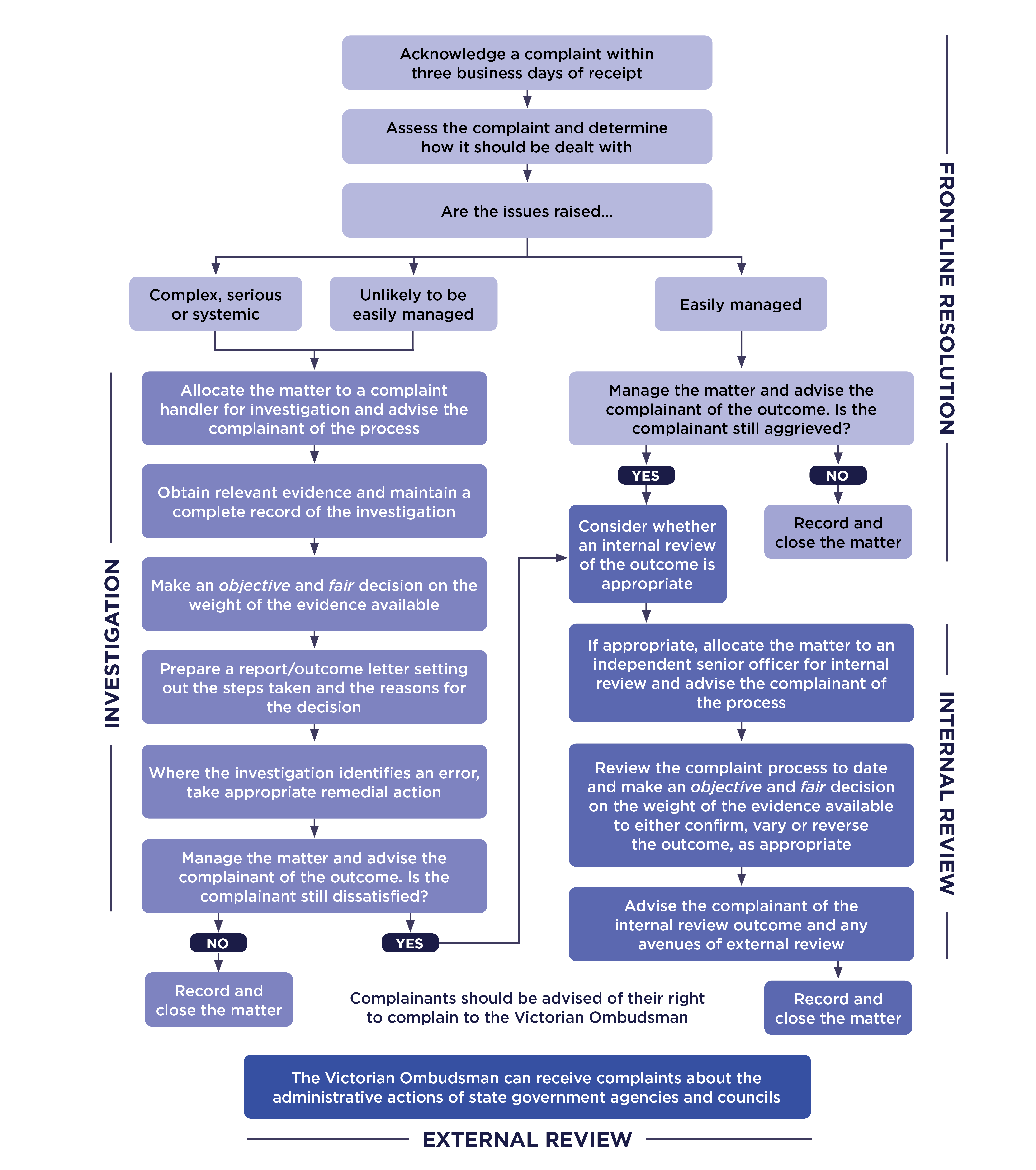
Appendix C: Example outcome letter
Download an editable MS Word version of this template
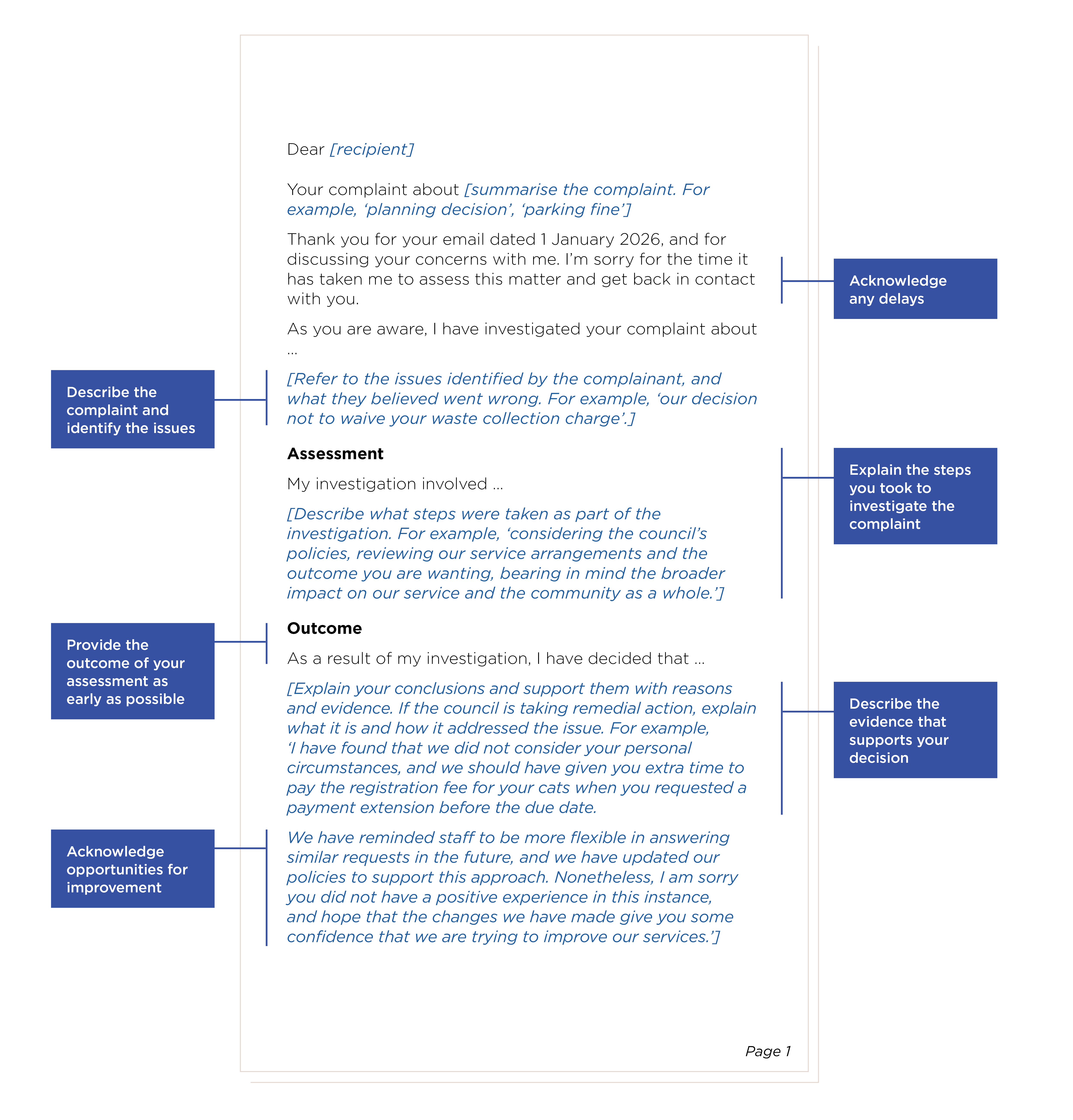
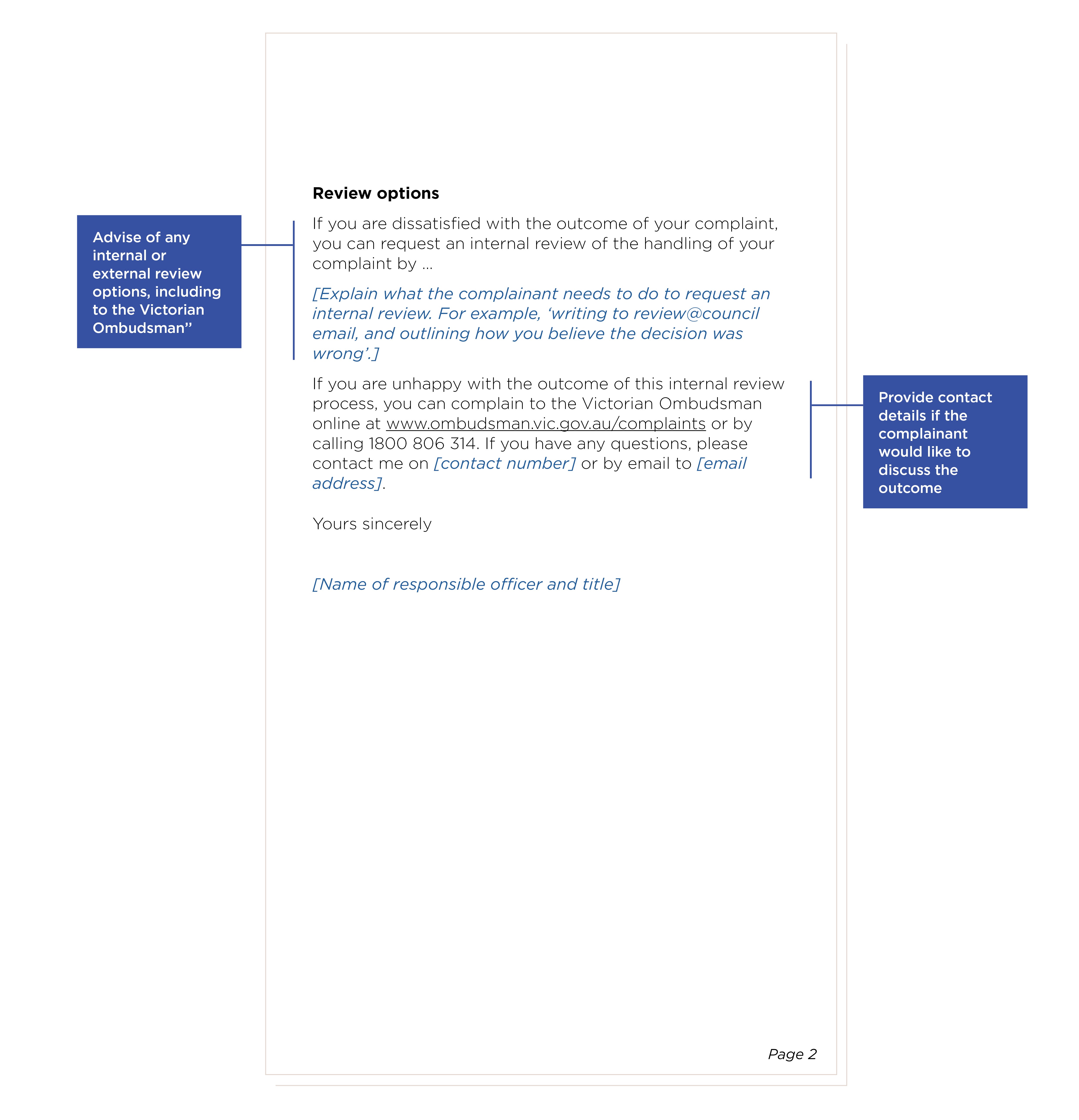
Appendix D: Additional resources
The following publications were used to help develop this guide and are useful resources for organisations wanting to know more.
Australian Standards, Guidelines for complaint management in organizations (AS 10002:2022, ISO 10002:2018)
Victorian Ombudsman, Good practice guide: Managing complex complainant behaviour, February 2022
Commonwealth Ombudsman, Better Practice Complaint Handling Guide , February 2023
New South Wales Ombudsman, Effective complaint management guidelines , 4th edition, November 2024
Ombudsman Western Australia, Effective complaint handling , January 2017
New South Wales Ombudsman, Managing unreasonable conduct by a complainant , 3rd edition, 2021
Independent Broad-based Anti-corruption Commission, Managing internal investigations , September 2023
Safe Work Australia, Model Code of Practice: Managing psychosocial hazards at work , August 2022
Victorian Equal Opportunity and Human Rights Commission, About the Charter (webpage), humanrights.vic.gov.au
Victorian Equal Opportunity and Human Rights Commission, The Charter of Human Rights and Responsibilities: A guide for Victorian public sector workers , January 2021
Victorian Public Sector Commission, Public sector values (webpage), vpsc.vic.gov.au
Centre For Accessibility Australia, What is the WCAG Standard? (webpage), accessibility.org.au
Victorian Government, Accessibility guidelines for government communications (webpage), vic.gov.au